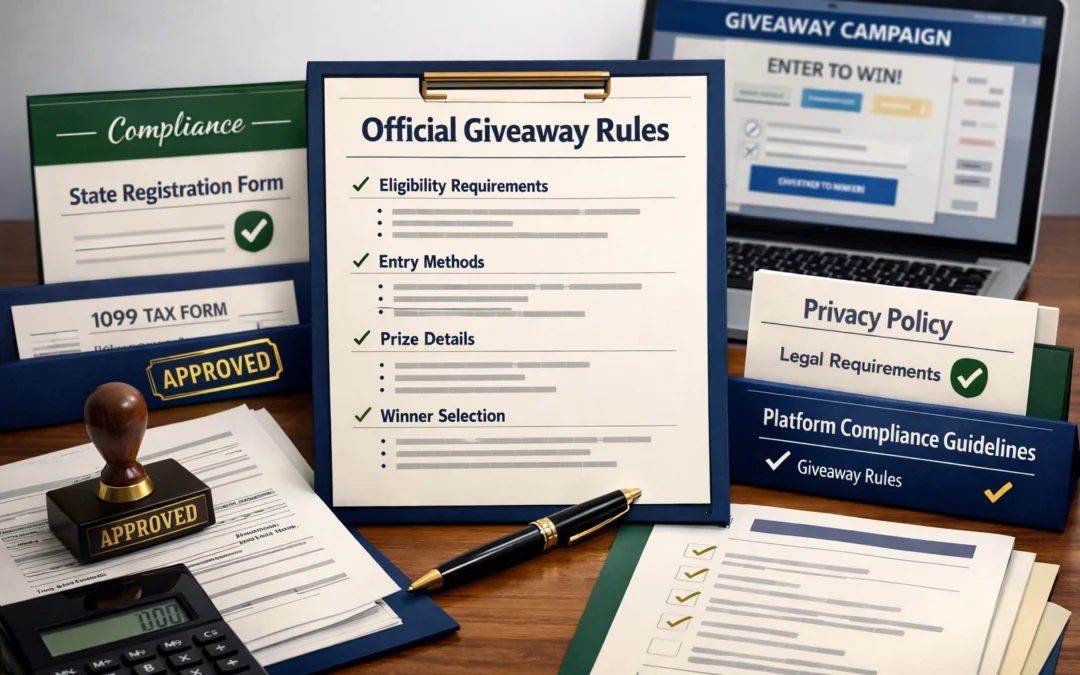
Launching or entering a sweepstakes involves a temporary legal partnership. While marketing teams focus on engagement metrics and entrants focus on winning, corporate counsel looks directly at risk. A promotional giveaway is legally structured as a binding contract wrapped in strict state and federal consumer protection laws.
When a prize is awarded, it triggers an immediate shift in legal and financial exposure. Understanding the exact boundaries of sweepstakes liability is essential for hosts trying to protect their corporate assets and winners trying to shield their personal finances.
I. The Host’s Burden: Minimizing Brand and Regulatory Risk
For a business or brand, an improperly structured promotional campaign can lead to class-action lawsuits, deceptive advertising penalties from the Federal Trade Commission (FTC), or enforcement actions by state Attorneys General.
1. The Anatomy of an Ironclad Liability Waiver
To avoid inheriting the risks associated with how a winner uses a prize, hosts utilize a mandatory Liability Release within the Winner’s Release Packet. By signing this document, the verified winner legally agrees to hold the sponsor, its advertising agencies, and its third-party fulfillment houses completely harmless from any damages, injuries, or losses resulting from the acceptance, possession, or use of the prize.
The Structural Limit: While a waiver easily protects a brand if a winner scratches their new tablet or misplaces a gift card, a boilerplate waiver will not shield a company if a physical prize causes severe injury due to a known manufacturing defect or corporate negligence.
2. Guarding Against Third-Party Trademark Infringement
A major operational liability for promotional marketers is the unauthorized inclusion of secondary brand assets. If your company purchases ten Apple iPads or five Peloton bikes to give away as entry incentives, you cannot use those brands' official logos, font layouts, or trademarks in your promotional graphics without explicit licensing agreements. Doing so implies a commercial endorsement or joint venture that does not exist, exposing your brand to immediate trademark infringement litigation.
-
The Compliant Fix: Marketers must use plain text to describe physical prizes (e.g., "Win a premium brand smart tablet") and include an explicit disclaimer stating: "This promotion is in no way sponsored, endorsed, or administered by [Brand Name]."
II. The Winner’s Burden: Post-Delivery Asset Risks
For a consumer, liability does not end the moment they sign the delivery receipt. Accepting an asset—especially high-value, complex prizes—introduces ongoing financial and civil responsibilities.
1. Mechanical, Operational, and Environmental Exposure
Once ownership is perfected and title transfer is complete, the winner inherits all operational liabilities of the asset:
-
Vehicles: If you win a luxury car, you assume immediate financial responsibility for registering the title, purchasing mandatory state auto insurance, and covering all future maintenance. If the vehicle is involved in a collision post-delivery, the sponsor bears $0 of the legal liability.
-
Real Estate: Winning a vacation home or property requires navigating localized environmental regulations, property taxes, homeowners' association (HOA) structural parameters, and structural maintenance codes.
2. The Progressive Bracket Trap: 2026 Tax Tracking
The most immediate and aggressive liability for any sweepstakes winner is the IRS. Under the One Big Beautiful Bill Act (OBBBA) of 2026, the administrative tracking framework is clearly defined:
-
The $2,000 Milestone: Sponsors are legally required to secure a completed Form W-9 and issue a Form 1099-MISC for any prize or cumulative wins crossing a Fair Market Value (FMV) of $2,000 or more.
- The Ordinary Income Reality: The IRS treats the FMV of a physical prize exactly like ordinary cash income. A $15,000 prize added to your annual earnings can spike your progressive tax bracket, exposing your entire income portfolio to a higher tax liability when you file the following spring.
Operational Liability Split
| Liability Category | Sponsoring Host Responsibility | Verified Winner Responsibility |
| Pre-Drawing Setup | Must maintain an AMOE path; register pools over $5k in NY/FL. | Must submit completely accurate, non-fraudulent entry data. |
| Tax Documentation | Must collect a Form W-9 and file a 1099-MISC for wins over $2,000. | Must report the prize's true FMV as ordinary taxable income. |
| Asset Fulfillments | Must ensure the prize matches the ARV stated in the official rules. | Must assume all local licensing, registration, and insurance fees. |
| Post-Delivery Use | Protected from casual misuse claims via the signed Liability Waiver. | Assumes 100% of civil liability for operational use of the asset. |
Shield Your Personal Assets with the KTS Guard
The complexities of sweepstakes liability prove that winning a major prize requires professional foresight. Many passionate entrants choose to intentionally forfeit their rewards or ignore winning notifications simply because they are intimidated by the sudden influx of legal releases and the impending threat of an out-of-pocket tax bill.
A Keep The Sweep (KTS) membership completely changes your sweeping strategy. For a $25 annual fee, our community-backed protection system shields your financial profile.
When you register your verified wins with us, KTS handles the heaviest financial liability of the hobby: the tax bill. Through our community-funded model, we settle the federal and state tax liabilities resulting from your promotional winnings directly with the authorities. KTS navigates the complex regulatory frameworks and manages the IRS compliance details so you can execute your winner's contracts confidently, absorb the asset liabilities easily, and enjoy your rewards in full.